Strategies to Make Program Assessment Simple in a Digital Era: A Case Study
Abstract
The assessment process of an undergraduate program is used as a case study to share some strategies to simplify the assessment process during a period where faculty members initiated the use of Tk20. Some strategies to establish an organized, and systematic academic program assessment process for the development and improvement of the academic program while implementing TK20 are identified. The strategies identified may help others to move forward in the assessment process and make it permanent and sustainable.
Introduction
The Metropolitan Campus (MC) is the largest academic unit of the Inter American University of Puerto Rico (IAUPR). IAUPR is a private, Hispanic-serving institution with nine academic units or campuses and two professional schools (School of Law and School of Optometry). MC was established in 1960. It is licensed by the Puerto Rico Council of Education (PRCE) and accredited by the Middle States Commission on Higher Education (MSCHE). It also has specialized professional accreditations for several programs. MC offers 106 higher education programs.
Since 2003, assessment became a priority at MC, yet by 2013 the assessment process was still in a beginning phase (Self-Study Report, 2013). Several actions were taken to ensure a systematic, continued and sustained assessment process. Among others, the level of responsibilities on assessment was clarified. To support academic unit in 2010, IAUPR acquired the Tk20 platform for the management of institutional and academic assessment. Tk20 platform implementation is coordinated by the Associate Vice President for Student Affairs of IAUPR, who is the Unit Administrator. Among other responsibilities, the Unit Administrator provides campus access to the Tk20 account, produces reports, reviews information from academic campuses, trains the trainers (mainly, the Campus Administrators), and provides follow-up activities.
Inter American University of Puerto Rico, Ponce Campus
Uso de herramientas de interacción en la enseñanza de estadísticas en línea: Retos y posibilidades
Resumen
En este artículo, se describe la utilización de variadas herramientas de interacción en dos cursos de estadística sub-graduados que se ofrecen por la modalidad de cursos a distancia. Estas herramientas permiten aumentar el diálogo en los cursos a distancia, lo que a su vez permite disminuir la distancia transaccional entre profesor y estudiante. Se describe cómo el investigador utiliza varias herramientas de interacción y comunicación, así como la preparación requerida para proveer actividades de interacción y comunicación, para estimular la integración de los estudiantes en las sesiones que ofrezco por esta modalidad, incluyendo el uso de métodos de comunicación complementarios y redundantes, entre otros.
Descriptores:
Distancia transaccional, enseñanza de estadísticas en línea, teaching statistics online.
Article 1: Evaluación de una certificación para docentes que enseñan en entornos virtuales.
Author: Dr. Ivette Torres Vera
Director Department of Chemistry
Associate Professor
Pontifical Catholic University of Puerto Rico
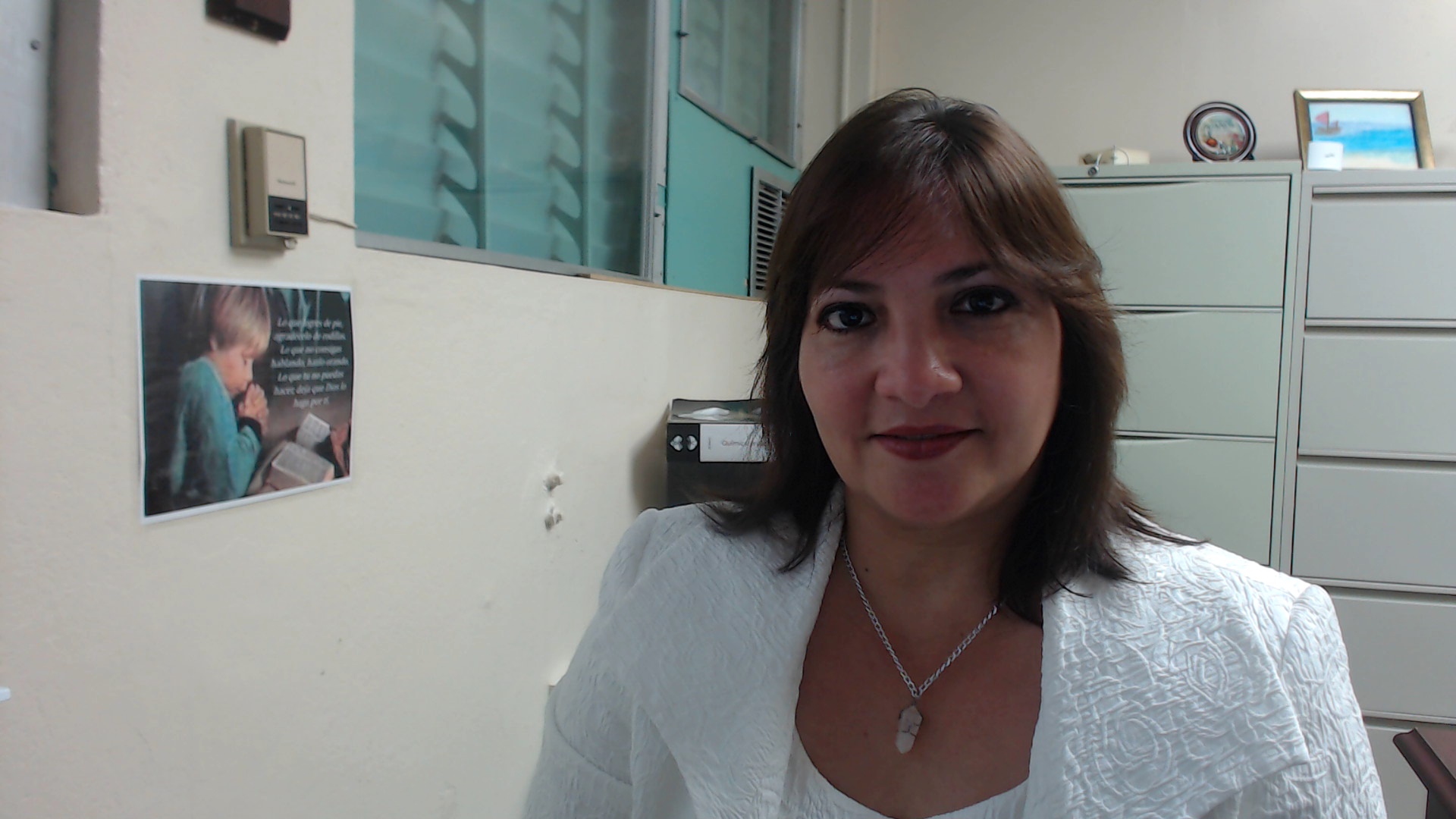
Dr. Ivette Torres-Vera is the Director of Department of Chemistry and Associate Professor at Pontifical Catholic University of Puerto Rico (PCUPR), Ponce Campus. She teaches online and face to face courses at PCUPR. Dr. Torres has a Doctoral Degree in Instructional Technology and Distance Education from the Abraham S. Fischler School of Education of Nova Southeastern University. She received Dr. Charles L. Faires Dissertation of Distinction Academic Awards 2015 from Nova Southeastern University. Dr. Torres has a Master Degree in Science – Specialization in Chemistry and a Bachelor Degree in Science – Specialization in Chemistry from the PCUPR. She has an Online Teaching Certificate from Sloan C 2010. Dr. Ivette Torres has been working in the field of online teaching and learning since 2006, planning, designing, and developing Physical Science Online Course and General Chemistry Blended Course at PCUPR. She has actively worked as a leader for the evaluation, development and reinforcement of the assessment processes and policies for online courses, f2f courses and instructional design. She has offered training workshops for faculty in the area of distance education and instructional design. Her current research interests include instructional strategies, online teaching and learning, faculty development, flipped classroom model and effective use of technology in the classroom to promote learning. She has presented her work in international and national conferences.
Article 2: Hostos Online Learning Assessment: A Survey of Student Percetions.
Author: Dr. Kate Wolfe
Associate Professor
Hostos Community College, CUNY, New York
Dr. Kate Wolfe is an Assistant Professor of Psychology at Hostos Community College, CUNY. She teaches a variety of psychology courses, including hybrid and online courses. She is currently the Principal Investigator of the Hostos Online Learning Assessment project and co-investigator on a project investigating quantitative reasoning skills among community college students. She is developing survey research project on attitudes about bisexual and transgender individuals in our urban community college sample. Her research interests include quantitative literacy among urban community college students, student perceptions of online learning, and urban college student attitudes toward sexual minorities.
Contact info:
Assistant Professor, Behavioral & Social Sciences Dept.
Online Learning Assessment Coordinator
Faculty Liaison to Education Technology
Hostos Community College, CUNY
Email: KWOLFE@hostos.cuny.edu
Author: Prof. Sarah L. Hoiland
Associate Professor, Behavioral and Social Sciences
Hostos Community College, CUNY, New York
Sarah L. Hoiland is an Assistant Professor of Sociology in the Behavioral and Social Sciences Department at Hostos Community College, City University of New York (CUNY). She has spent five years conducting ethnographic research on motorcycle club subculture in New York City and in Florida. Currently, she’s the principal investigator of a research project on this subculture and is working on a book about the largest “outlaw” women’s motorcycle club in the United States. This research was funded by a PSC-CUNY grant in 2014-2015 and again in 2016-2017. Her pedagogical research interests include online learning assessment and student perceptions of their quantitative reasoning and quantitative literacy abilities. She has been teaching hybrid courses and service-learning courses since 2009.
Contact info:
Assistant Professor of Sociology, Behavioral and Social Sciences Department
Hostos Community College, City University of New York (CUNY)
E- Portfolio (log in required): https://hostos.digication.com/professor_sarah_hoiland/Home
Author: Prof. Kate Lyons
Associate Professor, Library and Educational Technology
Hostos Community College, CUNY, New York
Kate Lyons is Head of Reference and the IT Librarian at the Hostos Community College Library (of The City University of New York). She is also a Faculty Liaison to the Department of Educational Technology. Kate Lyons holds an MS in Management from New York University’s Wagner Graduate School of Public Service, an MS in Library and Information Science from the University of Illinois at Urbana-Champaign, and a BA in English from Grinnell College.
Contact info:
Kate Lyons, Associate Professor, Department of Educational Technology
Hostos Community College, CUNY
Author: Carlos Guevara
Director, Educational Technology and CTL
Hostos Community College, CUNY, New York
Carlos Guevara holds a BS and Master degrees in Computer Science from CUNY & NYU Poly, and is currently pursuing his doctorate degree in Instructional Technology at Teachers College, Columbia University. With over 15 years of experience in Higher Education, Carlos works at Hostos Community College, CUNY, as Director of the Office of Educational Technology and Co-Director of the Center for Teaching and Learning. Carlos is also Chair or the HEO Organization at Hostos, and Founder of the Ecuadorian Youth Organization, and Ecuadorian Scholars Fund.
Assistant Professor, Behavioral and Social Sciences,
Hostos Community College, CUNY, New York
Dr. Kristopher Burrell is an Assistant Professor of History at Hostos Community College. He earned his doctoral degree in US History from the City University of New York-Graduate Center. His research interests include online learning assessment, in addition to 20th Century US and African American history. He has been teaching hybrid and asynchronous courses since 2014.
Contact info:
Kristopher Burrell, Ph.D.
Assistant Professor of History, Behavioral and Social Sciences Department
Interim Co-Coordinator Writing Across the Curriculum Program
Hostos Community College
Author: Dr. Jacqueline M. DiSanto
Assistant Professor,Education
Hostos Community College, CUNY, New York
Dr. Jacqueline M. DiSanto has been involved in online education since her doctoral studies, where she completed six of the required courses online. She has created online and hybrid course sections and mentors colleagues through the design and implementation process. She also shares her expertise in learning styles with participants in the Hostos Asynchronous and Hybrid Initiatives with particular attention paid to meeting the needs of both global and analytic processors in the online environment, and incorporating visual, auditory, and tactual resources into the site design. It is her strong conviction that the online environment is ideally suited to providing instruction that meets the emotional, environmental, physiological, psychological, and sociological learning-style traits of most students.
Contact info:
Jacqueline M. DiSanto, Ed.D.
Assistant Professor, Early-Childhood Education
Hostos Community College, CUNY
Email: jdisanto@hostos.cuny.edu
Author: Prof. Sandy Figueroa
Assistant Professor, Business
Hostos Community College, CUNY, New York
Professor Sandy Figueroa has been at Hostos Community College since 1976 as an adjunct and then in 1979 as an instructor in the Secretarial Science Department. Since 1999, Professor Figueroa has been teaching in the Computer Information Systems Unit. From 2003 until 2006, she was the chair of the Business Department. Currently, Professor Figueroa is the Coordinator for the Office Technology Unit of the Business Department. Professor Figueroa is chair of a number of college-wide committees and has served on a number of committees in the Business Department and the College.
Contact info:
Assistant Professor and Office Technology Coordinator, Business Department
Hostos Community College, CUNY
Email: mailto:SFIGUEROA@hostos.cuny.edu
Author: Dr. Aaron Davis
Instructional Designer, Educational Technology
Hostos Community College, CUNY, New York
Dr. Aaron Davis is a three-time graduate of the University of Delaware, with an undergraduate degree in Fine Art, and a Masters and Doctorate in Education. As an instructional designer, Dr. Davis specializes in incorporating new media communication techniques in education, by adapting content from traditional education towards 21st century learning.
Contact info:
Aaron Davis, BFA, M.Ed., Ed.D. Instructional Designer, Office of Educational Technology
Hostos Community College, CUNY
Website: http://www.aarondavisart.com/education
Author: Iber Poma
Coordinator of Student Services, Educational Technology
Hostos Community College, CUNY, New York
Iber Poma is a Computer Scientist interested in all modes of teaching and learning, especially hybrid and asynchronous. Have taught workshops to students considering to move from a face to face model to an online model. He is experienced with Lecture Capture and “Flip the Classroom” mode of instruction. He has led many initiatives out from the Office of Education Technology, including the iPads in the Classroom Initiative, in which iPads and apps are provided to students, thus bringing technology in the classroom.
Contact info:
Coordinator of Student Services, Educational Technology
Hostos Community College, CUNY
Email: ipoma@hostos.cuny.edu
Author: Wilfredo Rodríguez
Coordinator, Educational Technology
Hostos Community College, CUNY, New York
Wilfredo Rodríguez, office of Educational Technology Coordinator since April 2012. He have held different positions at the college. First as an ESL/Spanish tutor back in 2002 in the Coordinated Undergraduate Program (CFP). After working for two years in CFP and also facilitating writing workshops, he began working as an administrative assistance in 2004 for the Title V Grant. When the grant expired, went to work for the Office of Academic Affairs as a HEO where undertook different responsibilities. Rodríguez holds a M.S. and B.S. in Computer Science from Lehman College. After graduating, he continuously keep renovating knowledge in the field by researching the newest technology and how it adapts to education. He’s always fascinated by programming and how it improves productivity and human life in general. Rodríguez have been programming in Asp.net MVC framework for a couple of years and had developed two applications already.
Contact info:
Address: Hostos Community College – CUNY, 500 Grand Concourse, C-556, Bronx, NY 10451
Phone: 718-319-7973
Email: WRODRIGUEZ@hostos.cuny.edu
Author: Prof. Linda Ridley
Lecturer, Business
Hostos Community College, CUNY, New York
Linda Ridley is a Lecturer at CUNY’s Hostos Community College, where she teaches Entrepreneurship, Principles of Management, Principles of Marketing, and Introduction to Business. Additionally, she is an Adjunct Professor at other CUNY schools – the School of Professional Studies in the M.S. program for Business Management and Leadership, where she teaches Organizational Behavior and Leadership, and Managing Diversity in a Global Economy; and Baruch College’s Zicklin School of Business, where she teaches Business Communications I and II. As a complement to her teaching, Linda is CEO of Edgar J. Ridley & Associates, Inc., an international management consulting firm specializing in change management. Linda has been designated an Expert Consultant by the Asian Productivity Organization (APO) out of Tokyo, Japan, and she services global clients, conducting workshops and training seminars in workplace effectiveness. Linda has conducted training for women entrepreneurs from companies and organizations throughout Southeast Asia. Linda has the additional prestige of being on the faculty of the American Management Association, where her portfolio includes corporate training in analytical topics such as Critical Thinking,High-Impact Decision Making, and High Performance Accountability. Linda studied at Virginia Commonwealth University; she earned her Master’s in Business Administration from the Mason School of Business at the College of William and Mary in Williamsburg, Virginia. She and her husband, Edgar, reside in Harlem, New York City.
Article 3: Impact of Simulated Game on Learning and Engagement.
Author: Dr. Nina Sarkar
Assistant Professor, Business Department
Queensborough Community College, CUNY, New York
Nina Sarkar holds a doctoral degree in International Finance from the University of Houston, TX. Her research focus involved testing the dynamics of exchange rates within target zone regimes of the European Monetary System. After completing her PhD, she pursued a corporate career for 7 years as a Financial Analyst and Analytical Consultant in India, Singapore and in the US. Through her corporate career, she was always in touch with the academic world, serving as visiting lecturer or adjunct professor. She is a full time Assistant Professor at Queensborough Community College, CUNY. She teaches Principles of Finance and Principles of Statistics in the Business Department of Queensborough Community College, CUNY. She also serves as a Chair of the Committee on Course and Standing, an elected member of the Departmental Personnel and Budget Committee and a Coordinator of the Management track of the Business Department. Currently her research focus is on the scholarship of teaching and learning. She is especially interested in making an impact on student academic performances and uses innovative teaching techniques based on sound pedagogical practices to achieve that. During her time at Queensborough Community College, she has presented in several regional, national and international conferences and has published her research.
Author: Christina Manzo, MBA, CPA
Associate Professor, Business Department
Queensborough Community College, CUNY, New York
Christina Manzo is an Assistant Professor in the Business Department at Queensborough Community College in New York City. Prior to her present status, she was a Vice President – Senior Credit Analysis for the Dime Savings Bank of New York and an Associate Business Manager for the City University of New York. In her current position, she teaches accounting and other business related courses. Her research concerns comprise eLearning, flipped classroom model, technology in the classroom, and experiential learning.
President Emeritus
Queensborough Community College, CUNY, New York,
former Vice Chancellor
Community Colleges of the City University of New York (CUNY), and
former HETS Chairman
Eduardo Martí, served as Vice Chancellor for Community Colleges of the City University of New York and is president emeritus Queensborough Community College. Prior to his experience in NYC, he served as President of Corning Community College of the State University of New York (SUNY), and as President of SUNY’s Tompkins Cortland Community College. Dr. Martí also served as Executive Dean of Tunxis Community College (Campus CEO, CAO) and Acting President of Middlesex Community College, both located in Connecticut Dr. Martí serves on the Board of Trustees of Teachers College at Columbia University, as a member of the Board of Governors of the Council for Aid to Education, and as a member of Gateway to College Board of Directors. Previously, he served as a member of the NYS Governor’s Commission on Educational Reform. Previously, The College Board’s Advisory Board on Community Colleges as well as the Community College Research Center Advisory Board of Teachers College at Columbia University. Additionally, he served as Chair of the Board for the Hispanic Educational Telecommunications System (HETS). Having previously served on the Board of the American Association of Community Colleges (AACC), he was elected once again in March 2009-11. He was elected as a member of the Middle States Commission on Higher Education in October 2010. In 2011 he was appointed by Mayor Bloomberg to serve on the Panel for Educational Policy of the NYC Department of Education
Three times a graduate of New York University, Dr. Martí holds the Bachelor of Arts, Master of Science, and Ph.D. degrees in biology from the institution. He is the recipient of the Founders Day Award from New York University and was chosen as the recipient of the New York University Alumni Association’s Distinguished Alumnus Award in November 2007. In October 2008, the New York Post honored Dr. Marti with their Liberty Medal Award as a champion of human rights. He was previously named to the Honor Roll of the Phi Theta Kappa, the international honor society for two-year colleges. As the recipient of a Fulbright-Hays Seminars Abroad award, he spent June 2004 traveling in China with leaders of minority serving institutions
Article 5: Reinventing Remedial Reading in the 21st Century: A Review of the Benefits and Challenges of a Hybrid Remedial Reading Course.
Author: Prof. Toni Ann Hernen
Instructor, Department of Education and Reading
Bronx Community College, New York, NY
Toni Ann Hernen is an instructor in the Department of Education and Reading at Bronx Community College, since 2010. Here she teaches developmental reading, child development, and first year seminar. She earned her B.A. in History from Queens College, M.S. in Elementary Education from C.W. Post Long Island University, and is pursuing her Doctorate in Education from Northcentral University.
Her research interest includes effective instructional strategies to support the linguistically diverse student in college reading. She has presented at local and national conferences focusing on best practices in developmental reading. In addition, she has made numerous contributions to Bronx Community College’s Department of Education and Reading in the area of research and developmental reading support. Professor Hernen currently is a member of the Teaching Academic and Survival Skills Proposal Review Committee and is a member of the International Literacy Association. In March of 2016, she was asked to be part of the International Literacy Association’s small interest group meeting in Fort Lauderdale, Florida.
Professor Hernen is author of Blogging in the College Classroom, and has recently finished and co-authored Teaching Critical Literacy: Statistically Measuring the Effectiveness of this Instructional Method in the Community College Developmental Reading Classroom. She is also a member of her department’s research team and is leading the department’s “Reading Across the Discipline” lecture series.
Article 6: Strategies to Make Program Assessment Simple in a Digital Era: A Case Study.
Author: Dr. Edilberto Arteaga-Narvaez
Associate Professor, Natural Sciences Department
Inter American Univeristy of Puerto Rico, Metropolitan Campus
Edilberto Arteaga-Narváez, is an Associate Professor in the Natural Sciences Department at Inter American University, Metropolitan Campus in Puerto Rico. Dr. Arteaga received his Ed.D in Curriculum and Instruction in Sciences from the University of Puerto Rico, Río Piedras Campus. He also holds a MS in Physics from the University of Puerto Rico, Mayagüez Campus. From 2014 to present, he has served as assessment coordinator of Natural Sciences Academic Program. His research interests include physics learning, creative process in the learning and modeling of social systems through system dynamics.
Assistant Professor
Natural Sciences Department
Interamerican University of Puerto Rico, Metropolitan Campus
Dr. Kenia A. Parga Rivera has a BS in Chemistry, from the University of Puerto Rico-Río Piedras Campus, which she completed in 2004. She also holds a PhD in Inorganic Chemistry, from the University of Puerto Rico-Río Piedras Campus, which she completed in 2013. In order to obtain this degree, she successfully defended the thesis: Fe8-based MRI Contrast Agents Targeted to Breast and Ovarian Cancer Cells.
She began working at the Interamerican University of Puerto Rico-Metro Campus in 2014 as an Assistant Professor, where she teaches General Chemistry 1, General Chemistry 2, and Advanced Inorganic Chemistry, at the undergraduate level. Since August 2014, Dr. Parga has been a member of the BS in Natural Sciences Program Assessment Committee.
Associate Dean, Academic Affairs, and
Professor, Biology Department
Inter American Univeristy of Puerto Rico, Metropolitan Campus
Lillian Gayá González, PhD is a professor of Biology at the Department of Natural Sciences, Metropolitan Campus of the Inter American University of Puerto Rico. She served as President of the Standard 14: Assessment of Student Learning Subcommittee for the 2013 MSCHE Self-Study and is currently Associate Dean of Academic Affairs.
Contact info:
Email: lgaya@intermetro.edu Address: PO Box 191293, San Juan, PR 00919-1293
Office Phone: (787) 250-1912 X- 2527
Article 7: Uso de herramientas de interacción en la enseñanza de estadísticas en línea: retos y posibilidades.
Author: Marcos Torres-Nazario Ed.D. IR Certificate
Full professor
Distance Education Department
Inter-American University of Puerto Rico, Ponce Campus
Dr. Marcos Torres-Nazario teaches online and face-to-face courses of statistics and research, at the Inter American University of Puerto Rico (IAUPR) Ponce Campus. He received the degree of Doctor of Education in Educational Administration from the Inter American University Metro Campus. Also completed a Post Master Certificate in Institutional Research from Florida State University. In 2013 completed a Master Degree in Research and Evaluation at the University of Puerto Rico, Río Piedras Campus. During the Summer of 2015 completed the ELearning Expert Certificate from FATLA.
Article 1: Comparison of Student’s retention of core concepts in Traditional, Hybrid and Writing-Intensive Allied Health Microbiology and Infection Control Courses.
Author: Dr. Shazia Khan
Associate Professor
Biological Sciences Department
Bronx Community College, C.U.N.Y.
Nina Sarkar is an Associate Professor at Department of Biological Sciences, Bronx Community College of City University of New York. Prior to coming to BCC, she served as an Adjunct Lecturer at both Hostos Community College and Lehman College. While at Lehman College, earned her Doctorate in Biology (subprogram Plant Sciences) as a CUNY Graduate Center student. Sarkar joined BCC as assistant professor in 2003. There became interested in Pedagogical research when asked to put together a professional Development Plan, and believe that that was one of the best thing that happened to her, since it has allowed her to reflect on my teaching and to improve and grow as an educator.
Article 1: Advances in Technology Pave the Path to Actual Learning
Author: Prof. Toni Hernen- Brzeski
Instructor, Education & Reading Bronx Community College
Prof. Hernen-Brzeski joined Bronx Community College in 2010 as an adjunct lecturer in reading. She’s currently holding the position as an instructor in the Education and Reading Department. Prior to coming to Bronx Community College, she an elementary school teacher in both the Rockville Centre School District and the New York City Department of Education. Received her B.A. in History from Queens College and my M.A. in Elementary Education from C.W.Post Long Island University.
Her teaching interests include, remedial reading, child study, elementary education, and student development. Hernen-Brzeski also worked with the New York City Teaching Fellows Program where mentored and observed first year teachers. Developed a new course for the First Year Seminar Program for Bronx Community College and presented at the CUNY Conference for Best Practices. Along with her work at Bronx Community College, she have also helped pilot the first year debate team at York College.
Primary research interests are in the fields of elementary education with specific interests in pedagogy, child development, and effective use of technology in the classroom to promote learning. Currently reside on Long Island with husband and two children. In her free time she’s a youth girl’s lacrosse coach and enjoy exploring new and exciting attractions across the city and country.
Article 2: Análisis sobre los riesgos de seguridad generados por usuarios para las tecnologías de información y comunicación (TIC)
Author: Dr. Isabel Candal Vicente
Associate Professor Universidad del Este, Ana G. Méndez University System (AGMUS)
Isabel Candal Vicente is an Associate Professor of Management Information System at Universidad del Este, Ana G. Méndez University System (AGMUS). She received her Ph.D. from the San Pablo-CEU University, Spain. Her current research interests include data warehouse, data mining and information security. She has published, presented her work in many journals, and in international and national conferences.
Contact info:
Address: IEN, Business School, B-11 Paseo del Prado, San Juan, Puerto Rico 00926
email: icandal@suagm.edu Phone: (787) 398-5186
Fax: (787) 754-9665
Co-Author: Dania I. Osorio Concepción
Article 3: Factores que facilitan u obstaculizan el avalúo del aprendizaje en la educación general de las instituciones de Educación Superior.
Author: Dr. Mariela T. Collazo
Assistant Vice President for Planning Universidad Metropolitana
Her major areas of experience includes: development, implementation and evaluation of annual and long term Institutional Strategic Plan in Higher Education, Government Agencies and Corrections and Rehabilitation Programs. Monitor formative and summative evaluation of institutional development plans in Higher Education and Government Agencies. Ensure proper coordination between the plans, proposed development plan, according to the needs and priorities and fiscal projections. Support the assessment and institutional effectiveness and ensure that the findings and recommendations are integrated into development plans. Support the self-study for institutional accreditation and licensing processes in higher education. Evaluator of Research Proposals – US Department of Education/Title V Programs, needs assessment and or characteristics of labor market in higher education and government agencies, and assessment of the social, economic and urban situation of municipalities.
Some research are: Learning Assessment of General Education at a Private Higher Education Institution in Puerto Rico: a case study (2013), Conceptualizing a learning assessment model of general education for the School of Education of the Metropolitan University: analysis of the alignment of competencies and their development in the classroom (2010), and Models and learning assessment practices in general education (2010).
Dr. Collazo has a Ph.D. in Education – Specialization in Teaching (2013) from the Universidad de Puerto Rico, Rio Piedras Campus, a Master in Planning (license 722) from the Universidad de Puerto Rico, Cayey Campus and a Bachelor in Psychology (Magna Cum Laude, 1997).
Contact info:
Address: 1399 Ana G. Mendez Ave., San Juan, PR 00926
Phone: (787) 766-1717 Ext. 7418
Mobile: (787) 316-9739
Email: mcollazo@suagm.edu
Article 4: Impacto de aspectos visuales y estéticos en la Educación a Distancia.
Author: Dr. Lisbel M. Correa
Assistant Professor – Distance Learning Department Center of Innovation and Creativity in Education (CICE) Coordinator Distance Learning Associate Deanship Inter American University of Puerto Rico, Ponce Campus
Dr. Lisbel M. Correa Suárez is Assistant Professor of the Distance Learning Department, and the Coordinator of the Center of Innovation and Creativity in Education of the Distance Learning Associate Deanship. She owns a Doctored Degree in Instructional Technology and Distance Education of the Fischler School of Education of Nova Southeastern University, and a Master Degree in Educational Technology of Caribbean University. Dr. Correa also has successfully worked as an online instructor for sub-graduate and graduate Programs, and has also provide exceptional contributions by creating standardized processes for online courses instructional design. Has actively worked as a leader for the evaluation, development and reinforcement of the assessment processes of the Associate Dean of Distance Education. Furthermore, she designed the institutional training program for online instructors. As well as other online courses for sub-graduate and graduate program.
Article 5: La inteligencia emocional en la Educación a Distancia.
Author: Dr. Carmen Luisa Hernández
Full time professor EDP University of Puerto Rico
Carmen Luisa Hernández has a Bachelor’s Degree in Philosophy, and a Master’s Degree in Arts, with concentration in History from the University of Puerto Rico, Río Piedras Campus. She also has a Master’s Degree in Information Systems from EDP University and a Ph. D. in Educative Innovation from the Instituto Tecnológico de Estudios Superiores de Monterrey (ITESM).
Actually she works as a full time professor in EDP University and for over fifteen years she has taught in classroom and online mode in various universities of Puerto Rico. At EDP University she was in charge of the foundation and accreditation of the online program, and of the development of the politics and capacitation of professors of the online mode. She was in charge of the Technological Development Office and directed the Academic Institutional Assessment Committee. Currently she also offers her expertise knowledge in educative innovation through the Learning Consultant Corporation, LLC.
Article 6: La oferta académica en línea de Puerto Rico: Actualización a otoño 2014.
Author: Dr. Marcos Torres- Nazario
Full professor Distance Education Department Inter-American University of Puerto Rico, Ponce Campus
Dr. Marcos Torres-Nazario teaches online and face-to-face courses of statistics and research, at the Inter American University of Puerto Rico (IAUPR) Ponce Campus. He received the degree of Doctor of Education in Educational Administration from the Inter American University Metro Campus. Also completed a Post Master Certificate in Institutional Research from Florida State University. In 2013 completed a Master Degree in Research and Evaluation at the University of Puerto Rico, Río Piedras Campus. Recently, finished the ELearning Expert Certificate from FATLA.
Article 7: Los estudiantes a distancia de Puerto Rico: Datos por nivel y tipo de Institución.
Author: Dr. Marcos Torres- Nazario
Full professor Distance Education Department Inter-American University of Puerto Rico, Ponce Campus
Dr. Marcos Torres-Nazario teaches online and face-to-face courses of statistics and research, at the Inter American University of Puerto Rico (IAUPR) Ponce Campus. He received the degree of Doctor of Education in Educational Administration from the Inter American University Metro Campus. Also completed a Post Master Certificate in Institutional Research from Florida State University. In 2013 completed a Master Degree in Research and Evaluation at the University of Puerto Rico, Río Piedras Campus. Recently, finished the ELearning Expert Certificate from FATLA.
Article 8: Unified Communication Technology: The Considerations for Adoption for Administration and Pedagogy.
Author: Patricia Kahn, Ph. D.
Assistant Vice President for Technology Systems The College of Staten Island, CUNY
Patricia Kahn, Ph.D. is the Assistant Vice President for Technology Systems at the College of Staten Island (CSI) where she oversees the operations of all information technology services. Dr. Kahn has many years of service in higher education technology services. Prior to coming to CSI, Dr. Kahn served as the Executive Director of Information Technology Services at Brookdale Community College from 2009 – 2014. While at Brookdale, she oversaw and directed all information technology activities and was the focal point on technology for the campus community and the primary liaison with Educational Services and vendors providing services for the development and management of IT resources. Prior to Brookdale, Dr. Kahn obtained extensive experience in academic technology and distance learning during her nine year tenure at Montclair State University. There she held various administrative positions including Director of Technology Training and Integration.
Dr. Kahn received her BS in Computer Information Systems and an MBA in Finance from Manhattan College. She received her Ph.D. in Education from Capella University, with a concentration in Instructional Design and Online Learning. Her favorite past time is spending time with family and friends as well as her Wheaten Terrier.
Contact info:
Address: The College of Staten Island, CUNY, 2A-303A
Phone: 718-982-2209
Email: patricia.kahn@csi.cuny.edu
Using learner profiling technique to predict college students’ tendency to choose elearning courses: A two-step cluster analysis
Author 1 Cheng-Chang “Sam” Pan, PhD, PMP, MBA, is an associate professor of Educational Technology at The University of Texas at Brownsville (soon to be The University of Texas Rio Grande Valley). His current research agenda includes the design of elearning in the context of project management and strategic management of distance education enterprises. He can be reached at Sam.Pan@utrgv.edu
Author 2 Francisco Garcia, MEd, is the Manager of Distance Education, Online Learning, The University of Texas at Brownsville. He will soon become the Director of Center for Online Learning & Teaching Technologies at The University of Texas Rio Grande Valley). He can be reached at Francisco.Garcia@utrgv.edu
Keywords
college students; distance education enterprise, elearning; affinity for technology; separation of school life and personal life
Structuring Online & Hybrid College Courses By Janet Michello, Ph. D.
Associate Professor
Social Science
LaGuardia Community College of the City University of New York.
The world of education is rapidly changing as we move onward in the digital world. From pre-school to graduate school more instruction utilizes multimedia and digital resources and relies less on the printed word. Toddlers are playing games on iPads, kindergarteners are drawing and creating stories using laptops, middle school students are conducting online computer research, and college students are producing and submitting digital stories instead of research papers. Advantages of the increase in educational technology include education becoming more accessible, affordable, adaptable, and equitable (Bai & Smith, 2010). We have Ebooks and libraries that offer varied digitalized material and even a library with no books! The first bookless library recently opened at Florida Polytechnic University in central Florida. One of the attributes of such a library is that students can research and select material independently which often is easier and more productive than seeking assistance at a library’s help desk.
María del Carmen Malbrán
Senior Teacher,
University of Buenos Aires (UBA),
National University of La Plata (UNLP), Argentina
Abstract
Metalectura de textos informativos es un subproyecto del proyecto “Creencias epistemológicas acerca de la naturaleza del conocimiento” patrocinado por la Universidad de Buenos Aires (Argentina) para el período 2004 – 2007. El principio general considera que la lectura pone en juego creencias sobre la naturaleza y límites del saber consideradas como una categoría de pensamiento informal. Estas concepciones influyen en el conocimiento, el razonamiento, las estrategias de estudio, el procesamiento y monitoreo de la información, la organización del contenido y la evaluación de la propia comprensión. La lectura, práctica cognitiva por excelencia, es un factor crítico en los estudios universitarios. Quienes logran leer con provecho se encuentran en una situación privilegiada respecto de quienes poseen en menor grado esta cualidad. Un protocolo de lectura fue diseñado y aplicado a las cohortes 2004- 2005 (n 80) de alumnos de la cátedra Psicología Educacional, correspondiente al tercer año de estudios de la carrera de Educación, Facultad de Filosofía y Letras, Universidad de Buenos Aires. El análisis de los datos permite aceptar la validez de los fundamentos teóricos inspiradores de la experiencia.
En este artículo se actualiza a otoño 2013, los datos sobre la matrícula a distancia, las instituciones que ofrecen cursos por esta modalidad y el nivel educativo de estos ofrecimientos. También, se ofrece un estimado del tamaño del mercado de la educación a distancia en Puerto Rico. Al mismo tiempo, esta información se compara con la matrícula a distancia de Puerto Rico por nivel académico y sector educativo para otoño 2012 (Torres-Nazario, 2014). En general, se encontró un aumento de 36% en la matrícula de estudiantes, así como un incremento sustancial en la oferta de cursos a distancia por las instituciones de educación superior (IES) públicas del país. Por último, se estimó que para las 36 IES superior que ofrecieron cursos a distancia en otoño 2013, este segmento de mercado representó poco más de 133 millones de dólares de ingresos por concepto de matrícula y cuotas.
Prof. Christine Mooney
Associate Professor
Queensborough Community College, CUNY
and
Leslie L. Francis, Esq. Assistant Professor
Queensborough Community College, CUNY
Article Abstract
The cost of a textbook for an undergraduate course can average between $60.00 and $300.00. In particular, the cost of textbooks for Hispanic and other minority students can sometimes exceed the cost of their tuition. The increasing cost of commercial texts has led many students to find alternatives for the purchase of their required course text. Students may purchase an older or international version of the text, rent them, or buy e-books. Many students do not purchase the text for the course because they cannot afford the book in any format. The implementation of Open Educational Resources as a means of reducing the cost of student textbooks has grown dramatically in recent years. This paper outlines the development of the OER trend in community colleges in particular and discusses the practical applications for the development of a business law course at Queensborough Community College.