Sarah L. Hoiland is an Assistant Professor of Sociology in the Behavioral and Social Sciences Department at Hostos Community College, City University of New York (CUNY). She has spent five years conducting ethnographic research on motorcycle club subculture in New York City and in Florida. Currently, she’s the principal investigator of a research project on this subculture and is working on a book about the largest “outlaw” women’s motorcycle club in the United States. This research was funded by a PSC-CUNY grant in 2014-2015 and again in 2016-2017. Her pedagogical research interests include online learning assessment and student perceptions of their quantitative reasoning and quantitative literacy abilities. She has been teaching hybrid courses and service-learning courses since 2009.
Contact info:
Sarah L. Hoiland
Assistant Professor of Sociology, Behavioral and Social Sciences Department
Hostos Community College, City University of New York (CUNY)
E- Portfolio (log in required): https://hostos.digication.com/professor_sarah_hoiland/Home
Kate Lyons is Head of Reference and the IT Librarian at the Hostos Community College Library (of The City University of New York). She is also a Faculty Liaison to the Department of Educational Technology. Kate Lyons holds an MS in Management from New York University’s Wagner Graduate School of Public Service, an MS in Library and Information Science from the University of Illinois at Urbana-Champaign, and a BA in English from Grinnell College.
Contact info:
Kate Lyons, Associate Professor, Department of Educational Technology
Hostos Community College, CUNY
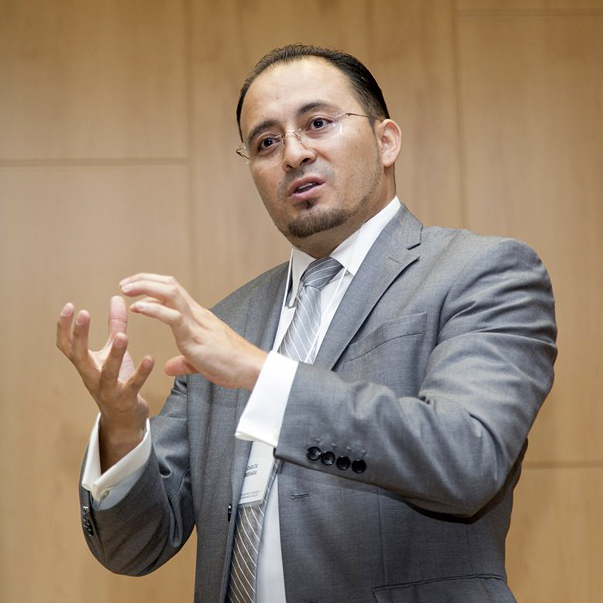
Carlos Guevara holds a BS and Master degrees in Computer Science from CUNY & NYU Poly, and is currently pursuing his doctorate degree in Instructional Technology at Teachers College, Columbia University. With over 15 years of experience in Higher Education, Carlos works at Hostos Community College, CUNY, as Director of the Office of Educational Technology and Co-Director of the Center for Teaching and Learning. Carlos is also Chair or the HEO Organization at Hostos, and Founder of the Ecuadorian Youth Organization, and Ecuadorian Scholars Fund.
Dr. Kristopher Burrell is an Assistant Professor of History at Hostos Community College. He earned his doctoral degree in US History from the City University of New York-Graduate Center. His research interests include online learning assessment, in addition to 20th Century US and African American history. He has been teaching hybrid and asynchronous courses since 2014.
Contact info:
Kristopher Burrell, Ph.D.
Assistant Professor of History, Behavioral and Social Sciences Department
Interim Co-Coordinator Writing Across the Curriculum Program
Hostos Community College
Dr. Jacqueline M. DiSanto is an Associate Professor and Unit Coordinator (for Early-Childhood Education) in the Education Department at Hostos Community College of the City University of New York. She earned a B.S. and M.A. in Business Education (NYU), a professional diploma in Administration (Fordham), and an Ed.D. (St. John’s University) in Instructional Leadership. Her areas of publication includes: online education, learning styles, translanguaging, and faculty development. She is a founding member of the Peer Observation and the Scholarship of Teaching and Learning Committees, and a member of the Instructional Evaluation Committee and college-wide Senate. She is a co-investigator in a grant-funded consortium for Open Educational Resources; Dr. DiSanto is coordinating the efforts to convert the complete 60-credit A.A.S. in Early-Childhood Education from for-pay textbook reliance to providing all content without charge to students.
Contact info:
Jacqueline M. DiSanto, Ed.D.
Assistant Professor, Early-Childhood Education
Hostos Community College, CUNY
Email: jdisanto@hostos.cuny.edu
Professor Sandy Figueroa has been at Hostos Community College since 1976 as an adjunct and then in 1979 as an instructor in the Secretarial Science Department. Since 1999, Professor Figueroa has been teaching in the Computer Information Systems Unit. From 2003 until 2006, she was the chair of the Business Department. Currently, Professor Figueroa is the Coordinator for the Office Technology Unit of the Business Department. Professor Figueroa is chair of a number of college-wide committees and has served on a number of committees in the Business Department and the College.
Contact info:
Assistant Professor and Office Technology Coordinator, Business Department
Hostos Community College, CUNY
Email: mailto:SFIGUEROA@hostos.cuny.edu
Dr. Aaron Davis is a three-time graduate of the University of Delaware, with an undergraduate degree in Fine Art, and a Masters and Doctorate in Education. As an instructional designer, Dr. Davis specializes in incorporating new media communication techniques in education, by adapting content from traditional education towards 21st century learning.
Contact info: Aaron Davis, BFA, M.Ed., Ed.D. Instructional Designer, Office of Educational Technology
Hostos Community College, CUNY
Website: http://www.aarondavisart.com/education
Iber Poma Coordinator of Student Services, Educational Technology
Hostos Community College of the City University of New York (CUNY)
Poma have worked in the Educational Technology field for over 20 years. He have earned an AA and a BS in Computer Science. He had also developed workshop curriculum and taught hybrid and fully Online Workshops for Students; and have participated in the creation of guidelines for Hybrid and Fully Online at Hostos for faculty. The “Are you Ready” tool in Blackboard for online students was created seeking to understand exactly what hybrid or online learning means at Hostos. Through his involvement in Educational Technology, he had seen first-hand that EdTech has the potential to become a catalyst of change for faculty–streamlining time-consuming processes (like lesson planning, reporting, and attendance) and simplifying communication through Blackboard. Poma feels that the engagement between faculty and students are one of the key ingredients to really embrace online teaching by using technology tools to accomplish this modality of learning.
Contact info:
Coordinator of Student Services, Educational Technology
Hostos Community College, CUNY Email:ipoma@hostos.cuny.edu
Wilfredo Rodríguez, works at the office of Educational Technology Coordinator since April 2012, after holding different positions at the college. He oversees the daily operations of the office and implement many different projects. He began as an ESL/Spanish tutor back in 2002 in the Coordinated Undergraduate Program (CFP). After working for two years in CFP and also facilitating writing workshops, he began working as an administrative assistance in 2004 for the Title V Grant. When the grant expired, he went to work for the Office of Academic Affairs as a HEO where undertook different responsibilities. Rodríguez holds a M.S. and B.S. in Computer Science from Lehman College, CUNY. After graduating, he continuously keep renovating and updating knowledge in the field by researching the newest technology and how it adapts to education. He’s always fascinated by programming and how it improves productivity and human life in general. Wilfredo also had been programming in Asp.net MVC framework for a couple of years already and already have developed many applications and supported many others that he inherited when the programmer left from the Educational Technology Department.
Contact info: Address: Hostos Community College – CUNY, 500 Grand Concourse, C-556, Bronx, NY 10451 Phone: 718-319-7973 Email:WRODRIGUEZ@hostos.cuny.edu
Linda Ridley is a Lecturer at CUNY’s Hostos Community College, where she teaches Entrepreneurship, Principles of Management, Principles of Marketing, and Introduction to Business. Additionally, she is an Adjunct Professor at other CUNY schools – the School of Professional Studies in the M.S. program for Business Management and Leadership, where she teaches Organizational Behavior and Leadership, and Managing Diversity in a Global Economy; and Baruch College’s Zicklin School of Business, where she teaches Business Communications I and II. As a complement to her teaching, Linda is CEO of Edgar J. Ridley & Associates, Inc., an international management consulting firm specializing in change management. Linda has been designated an Expert Consultant by the Asian Productivity Organization (APO) out of Tokyo, Japan, and she services global clients, conducting workshops and training seminars in workplace effectiveness. Linda has conducted training for women entrepreneurs from companies and organizations throughout Southeast Asia. Linda has the additional prestige of being on the faculty of the American Management Association, where her portfolio includes corporate training in analytical topics such as Critical Thinking,High-Impact Decision Making, and High Performance Accountability. Linda studied at Virginia Commonwealth University; she earned her Master’s in Business Administration from the Mason School of Business at the College of William and Mary in Williamsburg, Virginia. She and her husband, Edgar, reside in Harlem, New York City.
Evaluación de una Certificación para Docentes que Enseñan en Entornos Virtuales
Evaluation of a Certification for Professors who Teach in Virtual Environments
Resumen
Este artículo presenta los hallazgos de un estudio realizado para determinar cuán eficiente es la certificación que utiliza una universidad privada en Puerto Rico para enseñar las competencias del docente virtual. El estudio utilizó un enfoque de investigación cuantitativa no experimental con un diseño transeccional descriptivo. La población del estudio estuvo constituida por el personal docente que tomó la certificación para enseñar cursos híbridos y a distancia que ofrece la institución. Para la realización del estudio se utilizó una muestra probabilística. La muestra fue seleccionada utilizando la técnica de muestra aleatoria simple. Para lograr el propósito de este estudio se utilizó un cuestionario en línea adaptado de la Escala de Competencias del Docente Virtual de Ruiz (2010). El instrumento midió la opinión de los docentes sobre las competencias pedagógica, tecnológica, interpersonal y gerencial que se enseñaron en la certificación. Los hallazgos reflejaron que las variables años de experiencia en la educación superior y años de experiencia como docente en la institución son factores que influyen en la dimensión tecnológica y gerencial. Se evidenció la necesidad de revisar la certificación y de crear un proceso de evaluación para determinar el nivel de conocimiento adquirido por el docente de las dimensiones de enseñanza virtual.
Palabras Claves
Educación a Distancia, Desarrollo Profesional, Aprendizaje a Distancia, Educación Superior, Competencias del Docente Virtual
The Office of Education Technology (EdTech) at Hostos Community College and faculty members from various departments created the Hostos Online Learning Assessment (HOLA) Task Force to design a survey for gathering and assessing data about students’ perceptions of their online learning experiences. The task force wanted to utilize the survey results to identify strengths and weaknesses in online instruction and student preparedness for the online learning environment. Student perceptions of online learning are integral to building upon current best practices and also gauging the preparedness of the students for the online learning environment, particularly in an urban, Hispanic-serving community college. The survey and results will be discussed within the broader context of best practices and online learning assessments as well as the way the HOLA Task Force is utilizing the data to make meaningful changes in the survey instrument, in addittion planning for continuous improvement in online learning.
Keywords: online learning, asynchronous, hybrid, blended, student, community college, urban, Hispanic, African American
Today’s students are digital natives who have grown up with computer technology and video games. Their constant exposure to the internet and other digital media has shaped the way they receive, process and learn information. Consequently, the traditional lecture and textbook approach to education is not as effective for this generation. We believe that students can benefit from reality based computer simulated games which are incorporated into the course curriculum. Games and computer simulations are no longer just for fun; they can be used as an effective pedagogical tool to enhance learning and foster an engaged learning environment. While there is a general consensus among educators that educational games are an effective method of motivating students, there is a lack of empirical studies relating to the impact of this teaching modality on students’ academic performance and engagement. This paper reports on the effectiveness of using a computer simulated game on student learning and engagement in three different business courses.
President emeritus Queensborough Community College, former Vice Chancellor for Community Colleges of the City University of New York, and former HETS Chairman
* This article is an excerpt of the book “America’s Broken Promise: Bridging the Community College Achievement Gap” that will be published by Hudson Whitman/Excelsior College Press (2016)
Mending the Broken Promise: Our Students, Our Teachers, Our Missions
Unfettered access, a major component of the democratic promise of community colleges, has, over the years, morphed from a guiding inspiration to a required mandate. Contemporary community colleges continue to offer the most generous point of entry to incoming students seeking a postsecondary education. By implicitly and usually explicitly promising to provide a home to all potential students, community colleges promise to meet their ever more widely variable academic, financial, and social needs. Community colleges promise to enable all students to meet their divergent goals for education; consequently, community colleges promise to help all students achieve their dreams.
Bronx Community College, City University of New York
Author’s Note
Toni Ann Hernen is a lecturer in the Department of Education and Reading
Correspondence relating to this Article should be addressed to Toni Ann Hernen Bronx Community College, City University of New York, Colston Hall, Room 429, University Avenue, Bronx, New York 10453.
Remedial courses have been the center of attention over the past decade. More students enter college and take at least one remedial course because they have failed the entrance exams that determine if students have the basic skills to take credit bearing courses. The increase in enrollment for these courses has left administrators to find other sources and programs to accelerate the process. Students who are not accelerated through the remedial courses are sometimes left with taking more than one remedial in a semester. This setback can potentially delay the student’s matriculation and eventually cause the student to drop out of college. This paper examines a first year pilot hybrid remedial reading course offered in the Fall of 2015. Further, this small-scale study illustrates the benefits and effects of a hybrid remedial reading course and provides future recommendations for achievement. Using qualitative and quantitative data, the hybrid remedial reading course was determined to provide positive outcomes when comparing the treated and non-treated groups. It was further observed that the students found the course to be innovative and spark their interests. The promise of a new alternative to remedial reading in the 21st century has the potential to boost student attainment, matriculation, and progress.


 Sarah L. Hoiland is an Assistant Professor of Sociology in the Behavioral and Social Sciences Department at Hostos Community College, City University of New York (CUNY). She has spent five years conducting ethnographic research on motorcycle club subculture in New York City and in Florida. Currently, she’s the principal investigator of a research project on this subculture and is working on a book about the largest “outlaw” women’s motorcycle club in the United States. This research was funded by a PSC-CUNY grant in 2014-2015 and again in 2016-2017. Her pedagogical research interests include online learning assessment and student perceptions of their quantitative reasoning and quantitative literacy abilities. She has been teaching hybrid courses and service-learning courses since 2009.