
Primer for Teaching Online
6. Effective Online Assessment

Designing Meaningful and Aligned Assessments
The online learning environment offers a wide range of opportunities to assess student learning beyond traditional exams. While tests and quizzes remain relevant, effective online assessment relies on a diverse, aligned, and intentional mix of methods.
Using multiple assessment strategies allows instructors to:
- Foster engagement and higher-order thinking
- Gain a more accurate understanding of student learning.
- Support different learning styles and competencies.
Collaborative Assessment: Group Work

Group-based activities provide opportunities for collaboration, communication, and applied learning.
Best practices include:
- Using rubrics to assess both process and outcomes
- Assigning rotating roles (e.g., facilitator, moderator, recorder) to develop leadership skills
- Structuring projects with clear milestones and deliverables
- Incorporating peer evaluation alongside instructor feedback
Tests and Quizzes
Online quizzes and exams remain effective for assessing foundational knowledge and comprehension. Most modern LMS platforms (e.g., Blackboard Learn) support:
- Multiple formats (multiple choice, true/false, matching, short answer, essay)
- Automated grading and immediate feedback
- Analytics (e.g., time on task, item analysis, performance trends)
Strategic use:
- Combine with higher-order assessments to avoid over-reliance on recall
- Use for low-stakes, frequent checks for understanding
Discussion-Based Assessment
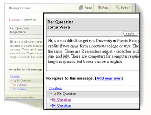
Online discussions are a powerful tool for assessing critical thinking, reflection, and engagement.
Effective implementation:
- Leverage LMS tracking tools to monitor participation.
- Pose open-ended, application-based prompts.
- Require initial posts and peer responses.
- Evaluate contributions using clear criteria (e.g., depth, relevance, and evidence-based reasoning).
Assignment Submission and Feedback
Most LMS platforms include assignment submission tools that streamline evaluation and feedback.
Benefits:
- Centralized submission and grading
- Opportunities for timely, personalized feedback
- Options for peer review and collaborative critique
Assignments can be shared in discussion forums or peer-review settings to promote deeper engagement and reflection.
Electronic Portfolios (ePortfolios)
ePortfolios provide a comprehensive, longitudinal view of student learning.
Advantages:
- Extend beyond a single course, offering value for academic and professional development
- Showcase progress over time
- Encourage reflection and self-assessment
- Support demonstration of competencies and applied skills
Additional Resources
- Evaluation and Assessment, Carnegie Melon University
- My Learning and Class Portfolio, University of Washington
